









|
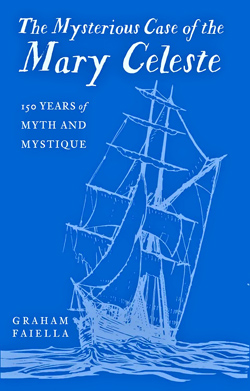
In his modern book "The Mysterious Case of the Mary Celeste: 150 Years of Myth and Mystique" published 14th July 2022 the author unveils those stories - the 'fake news', 'alternative facts' and the myths fabricated from fractured truths. These are the real facts in search of a truth that remains unfathomable to this day. |
In a podcast for The Mariners Mirror published by The Society for Nautical Research, he talks about The Mary Celeste and explains the history of derelict ships.
What Graham Faiella has to say:
The thing is in the 19th century there were an awful lot of what were called derelicts, just derelicts that drifted around
They were abandoned for reasons generally speaking of weather or collision with another vessel or something like that, or any number of perils of the sea. And usually they drifted around literally in their hundreds; there are tabulations by Lloyds, who do all the shipping information each year, how many derelicts were found. So those are the number of derelicts found, and they are two to three hundred and this by the way is mainly in the North Atlantic.
There was a lot of shipping going on but the North Atlantic was the scene where you often found derelicts at se for one reason or another. But the difference with the Mary Celeste is that they were often left to wander, there's no reason to take them in as a prize, to make a salvage claim, because they were usually so dilapidated, half underwater; if they were wooden ships, for example, dismasted, they were usually when you say derelict, they were a wreck you know.
I've often thought about that because there were a lot of derelicts but not that many were brought in as salvage claims. For one thing, a lot of them were just left to drift or sink, and not that many were brought in for salvage claims. But the other thing was that it was very unusual to find the ship under sail abandoned. But what made it significant too was that she was under her own power as it were, sail, under saii with no one on board. And the fact that she was sailing even in a derelict condition with no one on board made it more curious. The other fact that made it more curious is that the Court of Inquiry at Gibraltar was extensively reported by the local press and Lloyds of London, Lloyd's List, and Shipping and Mercantile Gazette and other shipping information as well. So it was quite common news at the time, and bearing in mind also that people in those days were more interested in shipping, generally speaking than they are today today, because they were so much closer to that sort of business.
The North Atlantic was one of the busiest shipping corridors in the world, linking Europe, North America, Africa, and the Caribbean. Merchant ships, fishing vessels, naval ships, and whalers all crossed these waters.
Severe weather played a major role in creating derelicts. Hurricanes, winter gales, and fog could damage rigging or sweep sailors overboard, leaving ships unable to continue safely. If a crew believed their vessel was about to sink, they might abandon it, only for the ship to later remain afloat and drift for months or even years. Disease was also a factor.
Derelict ships posed serious dangers to other mariners.
Floating low in the water and often unlit, they could be nearly
invisible at night or in rough seas, rather like discarded containers
in modern times, which are a serious risk to yachts.
Collisions with derelicts damaged or sank many ships, prompting
naval authorities and shipping companies to report sightings and,
when possible, destroy abandoned vessels.
